

Collagen is the most over-claimed ingredient in hair care, and most of the claims are not small exaggerations. They are a different mechanism entirely. This is not an argument against collagen masks. It is an explanation of what a topical protein actually does on a strand of hair, so you can buy the right product and judge it on the right things. Five collagen hair myths, each with the mechanism behind it, and what the evidence supports instead.
What collagen actually is on your hair
Before the myths, the biology. It is short, and everything else follows from it.
Hair is dead keratin, not collagen
Your hair is a fibre made of keratin, built by living cells in the follicle, and it is finished the moment it leaves the scalp. It has no blood supply, no cells, no metabolism and no ability to heal itself. Collagen is a different protein entirely, one that belongs to connective tissue. Collagen cannot bond to a living follicle, and it is not what your hair is made of.
This matters because every myth below starts by treating hair as something alive that can be fed. It is not. Nothing you apply from a bottle reaches the follicle, and nothing you apply to a strand of dead keratin can change what that fibre is made of.
The mechanism behind a protein film
What a topical collagen or keratin product does is physical and simple. Protein molecules in a haircare formula are broken into small pieces, usually by hydrolysis, so they are small enough to spread over the surface of the cuticle. They settle onto the outer layer of the strand and form a thin, smooth film. That film does three useful things: it flattens a lifted or damaged cuticle, it fills the gaps between the cuticle flakes so the fibre feels smoother, and it lowers friction so a comb slides rather than snags.
Notice what is not on that list. The film does not re-form broken disulphide bonds, does not grow the hair, does not repair a split end and does not reach the follicle. It behaves like a thin, temporary coating that makes the hair handle better. That is a genuinely useful effect. It is just a completely different effect from the one most collagen marketing implies.

Myth 1: collagen rebuilds hair from the inside
The claim: collagen hair treatments repair damaged hair from the inside out, strengthening the structure of the strand itself.
Why it does not hold: there is no inside to get to. The hair shaft has no living cells and no internal chemistry a topical can alter, and collagen cannot form a new bond with the keratin already in the fibre. A protein film forms on the outside of the cuticle: it sits on the surface, does not become part of the shaft, and rinses out over the following washes.
What the evidence supports: a smoother, lower-friction surface, less tangling, less frizz in the short term, and a measurable reduction in breakage because less hair is being pulled. If your hair has been bleached and the internal structure is genuinely broken, no cream changes that. Trimming does, and time does.

Myth 2: collagen is a protein your hair makes itself
The claim: hair makes collagen, so topping it up can only help.
Why it does not hold: the follicle makes keratin, from amino acids it takes from the blood, and that is the protein your hair is. Collagen is a separate protein, produced in connective tissue. It is not part of the hair shaft, and applying more of it does not “top up” anything the follicle was running short of. The follicle makes new keratin at the rate it makes new hair: one centimetre a month, roughly, whatever you put on the ends.
The second half of the claim, that more is better, fails for a separate reason: a protein film has a saturation point. Once the cuticle is coated, extra product does not build more useful structure, it builds residue. Hair coated past that point feels coated, looks dull and gets heavy, and over-stiffened hair becomes brittle. More is not better. More is just more.
Myth 3: more protein is always better
The claim: damaged hair needs protein, so the more protein treatment you use, the more it repairs.
Why it does not hold: protein raises the stiffness of the hair and adds hold, and that is exactly what it is for. Push it past the point the hair can handle and you get a fibre that is rigid rather than resilient. A rigid fibre is not a stronger fibre; it is a brittle one, and it breaks more readily under tension. This is why overuse of protein treatments is a genuine problem rather than a marketing scare: hair that feels straw-like, rough and crunchy when it is dry is over-proteined.
What the evidence supports: balance. Protein gives body and hold, moisture gives softness and flexibility, and damaged hair needs both. A protein treatment followed by an oil or a leave-in is not a contradiction; it is the two halves of one routine. Our guide to when and why you need hair protein treatments covers how often to use them and what to look for.
The one thing that will not work is a protein-only routine on hair that is dry. If your hair is thirsty, the first thing to fix is water, not protein.
Myth 4: collagen is a new ingredient
The claim: collagen is a brand-new discovery in haircare that older brands cannot offer.
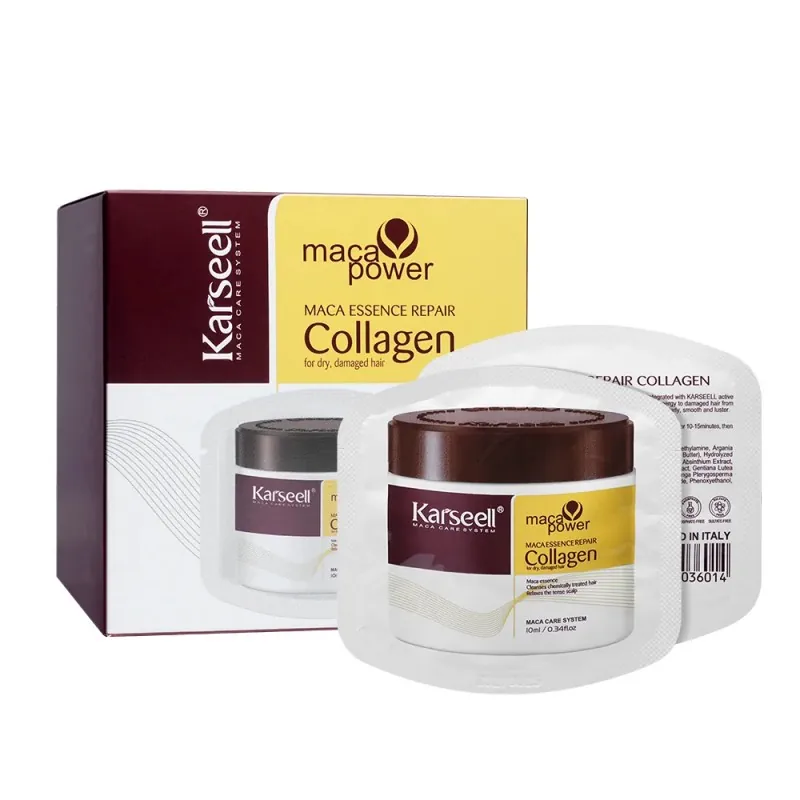
Why it does not hold: hydrolysed collagen has been an ingredient in shampoos, conditioners and treatments for decades, and the underlying science has not moved. A collagen product today does what a collagen product did decades ago: deposit protein film on the cuticle. What has changed is packaging and positioning, not the mechanism. You will find collagen in single-serve sachets, in sets bundled with an oil, and in “collagen complex” formulas.
This is not a knock on the modern formats, which are sometimes genuinely more useful. Single-serve sachets make a mask easy to test and to travel with, and a bundle that pairs a mask with an oil solves a routine problem a jar alone does not. It is only the novelty claim that does not survive contact with the ingredient list.

Myth 5: collagen results are instant
The claim: one application rebuilds your hair, and you will see the difference the moment you rinse.
Why it does not half hold: some of it is real, and the honest answer separates two different results. One use does change how the hair feels almost immediately. The Karseell Collagen Hair Mask is described as working in 5 to 10 minutes for softer, shinier hair, and that is consistent with how a film-forming protein behaves: it smooths the cuticle on contact, so the surface reflects more light and catches on the comb less. The shine you see straight after rinsing is largely that surface reflection.
What is not instant is the result that matters. A lower breakage rate, less frizz over a fortnight, softer hair across the whole head and a change in texture that survives a wash cycle take weeks of consistent use, because the effect is cumulative and because it is only as good as your detangling and heat habits. It is also temporary, and that is the part the marketing skips: the film rinses out, and you have to keep using the product to keep the result.
What a collagen product can really do
Judged honestly, a collagen mask is a conditioning product with a protein film on top of it. That is a good thing to be. It smooths, it detangles more easily, it reduces friction, it can add body and shine, and it makes hair noticeably more manageable while it is in use. It cannot repair a broken bond, re-join a split end or change what your hair is made of.
The Karseell collagen range compared
| Product | Price | Rating | Reviews | What it is, and what to expect |
|---|---|---|---|---|
| Karseell Collagen Hair Mask 500ml | $15.99 | 4.98 out of 5 | 1063 | Collagen, keratin and argan oil in 5 to 10 minutes; the everyday weekly mask for dry, damaged and colour-treated hair |
| Karseell Collagen Hair Mask 24 packs | $19.79 | 4.95 out of 5 | 236 | Collagen and argan oil in single-serve sachets, described as penetrating hair fibres to repair split ends, restore elasticity and strengthen brittle hair |
| Karseell Collagen Hair Mask and Purple Hair Mask | $49.99 | 4.99 out of 5 | 520 | A collagen mask plus a colour-depositing purple mask for brassy blonde or silver tones |
| Karseell Collagen Hair Treatment and Power Shampoo | $43.99 | 4.98 out of 5 | 149 | Collagen, argan oil and herbal extracts alongside a moisturising shampoo for dry hair |
Two notes on that table. The 24-pack at $19.79 works out at roughly $0.82 a sachet, which makes it the cheapest way to try the format before committing to a jar, and the easiest option for travel. And on the purple mask bundle: a toning mask is not a dye. It deposits colour to counteract brassiness and fades out over several washes, so it will not lighten your hair or change your base shade, and the usual strand test still applies. Its product page describes the formula as paraben-free and sulfate-free. You can browse the full hair mask range to compare the formats.
How to use collagen without overdoing it
The mechanism makes the method straightforward. Apply it to damp hair after shampooing, work it through the mid-lengths and ends, leave it for the time on the label, and rinse it out thoroughly. One mask a week is a sensible default for dry, damaged or colour-treated hair; every two weeks is enough for fine hair that gets weighed down quickly. Between washes, use an oil or a leave-in to keep the fibre flexible, which is the half of the balance protein cannot do on its own.
Watch for the over-protein signs, because they creep up slowly: hair that feels straw-like and rough when it is dry, that looks dull rather than shiny, that snaps instead of stretching, or that feels coated and stiff. If you notice them, stop the protein step for a fortnight and keep the moisture step going. Our guide to hair porosity will tell you whether your hair is absorbing everything you give it or holding nothing, which changes how much product it needs. For the longer explanation of the science, our articles on whether collagen for hair really works and the science behind collagen hair treatments go deeper.

Frequently Asked Questions
Does collagen rebuild damaged hair?
No, it rebuilds nothing. Collagen forms a film on the outside of the cuticle, which smooths the surface, lowers friction and makes the hair easier to handle. That reduces breakage, because less hair is pulled during detangling. But it does not re-form broken bonds, re-join a split end or change the internal structure of the fibre. The Karseell Collagen Hair Mask at $15.99, rated 4.98 out of 5 from 1063 reviews, is a good example of a product that works well within those limits.
Is collagen better than keratin for hair?
They are not really competitors, because they do different jobs. Keratin is the protein your hair is made of, which is why keratin products tend to feel firm and add hold. Collagen is a different protein used mainly as a film-former and smoother. Many formulas, including the Karseell Collagen Hair Mask, contain both for exactly that reason. What matters more than the name on the front is whether the formula leaves your hair soft or stiff, and whether you can keep using it without the hair becoming straw-like.
How often should I use a collagen hair mask?
Once a week for dry, damaged, bleached or colour-treated hair, and every two weeks for fine or low-porosity hair. If your hair feels coated, oily by the second day, or rough and straw-like when it is dry, you are using it too often or using too much. Back off for a fortnight and add an oil or leave-in between washes to keep the balance.
Will collagen fix my split ends?
No. A split end is a physical separation in the fibre, and only trimming removes it. What collagen can do is make the surrounding hair smoother and less snag-prone, which slows the rate at which new splits appear and helps the ends that have not split yet. If you want to know how to slow the process down, our guide to the ingredients to look for in a hair mask and our explainer on the science behind collagen hair treatments both cover the practical side of that.
