

Every few weeks, someone asks whether a toning shampoo will fix their brassy blonde hair, and the honest answer is: it depends entirely on what is actually causing the brassiness, and a toning shampoo does something quite specific rather than something general. Get that clear and the rest is straightforward.
This guide explains what a toning shampoo is, how it differs from a purple mask and from a blue toning product, how to use one without staining your hair, and how often to reach for it.

What a Toning Shampoo Actually Is
Colour theory is the whole mechanism, and it takes about thirty seconds to understand. Bleached hair, and blonde hair in general, carries warm undertones — yellow and orange. Add those two warm tones together and you get brass, which is why blonde hair looks golden, brassy or “orange peel” as it fades.
A toning product adds a counter-pigment that visually cancels the warmth. Violet cancels yellow. Blue cancels orange. The result is not new colour added to your hair — it is the unwanted colour being neutralised by its opposite.
The colour-wheel shortcut
It works the same way paint does, and this is why toning is unpredictable on dark or warm hair. Counter-pigments work by absorption: the violet particles in a purple shampoo are there to absorb the yellow reflection. On hair with plenty of yellow, they have something to work with. On hair that is naturally dark brown, there is almost no yellow to absorb, so the pigment has no purpose and simply sits there — which is why toning on natural dark hair either does nothing or looks flat and dull.
Two practical consequences fall out of this:
- Toning needs a light base. The Karseell Purple Hair Mask product page states it directly: it is designed for bleached hair at level 8 and above, and natural dark hair will not show results.
- Yellow and orange need different counters. If your blonde is going yellow, you want violet. If your silver or ash is going orange, you want blue. Using the wrong one does nothing useful.
Toning Is Not Hair Colour
This is the part that gets confused most often, and the Karseell Purple Hair Mask page is unusually blunt about it: “our hair mask is not a hair colorant, it can’t dye the hair.” That single line settles the argument.
Toning does not lift your level, it does not add melanin, and it does not give you a new shade of blonde. What it does is put a temporary film of pigment on the outside of the fibre so that the warmth underneath stops showing. It washes out over a handful of washes, which is exactly why it has to be repeated.
There is a practical benefit to this that people often miss: because toning only affects the surface, it is a very low-risk thing to do at home. You are not committing to a permanent chemical change. The downside is equally obvious — you are renting the result, not owning it.
Which tones it works on
| Your hair looks | The warmth underneath | Counter-pigment needed | Where you will find it |
|---|---|---|---|
| Yellow or golden | Yellow | Violet | Purple shampoo and purple masks |
| Orange or brassy | Orange | Blue | Blue colour-depositing masks |
| Flat, greyish, dull | Not a tone problem | None | You need moisture and a clarifying wash instead |
| Natural dark brown | None to cancel | None | Toning will not work here |
That third row matters. If your blonde has gone flat and ashy rather than warm, more toning will not help — it will make it worse. Build-up and dryness produce a dull, greyish-lilac cast that people often misread as needing a stronger toner.
Toning Shampoo vs Toning Mask
They contain a similar idea and they behave very differently in practice, because of contact time.
| Toning shampoo | Toning mask | |
|---|---|---|
| Contact time | A couple of minutes | 5 to 15 minutes |
| Deposit strength | Lighter, more gradual | Stronger, more noticeable |
| Conditioning | Minimal | Substantial — it is a conditioning mask first |
| Best used for | Maintenance between salon visits | A deliberate brassiness reset |
| Staining risk | Lower | Higher on porous hair |
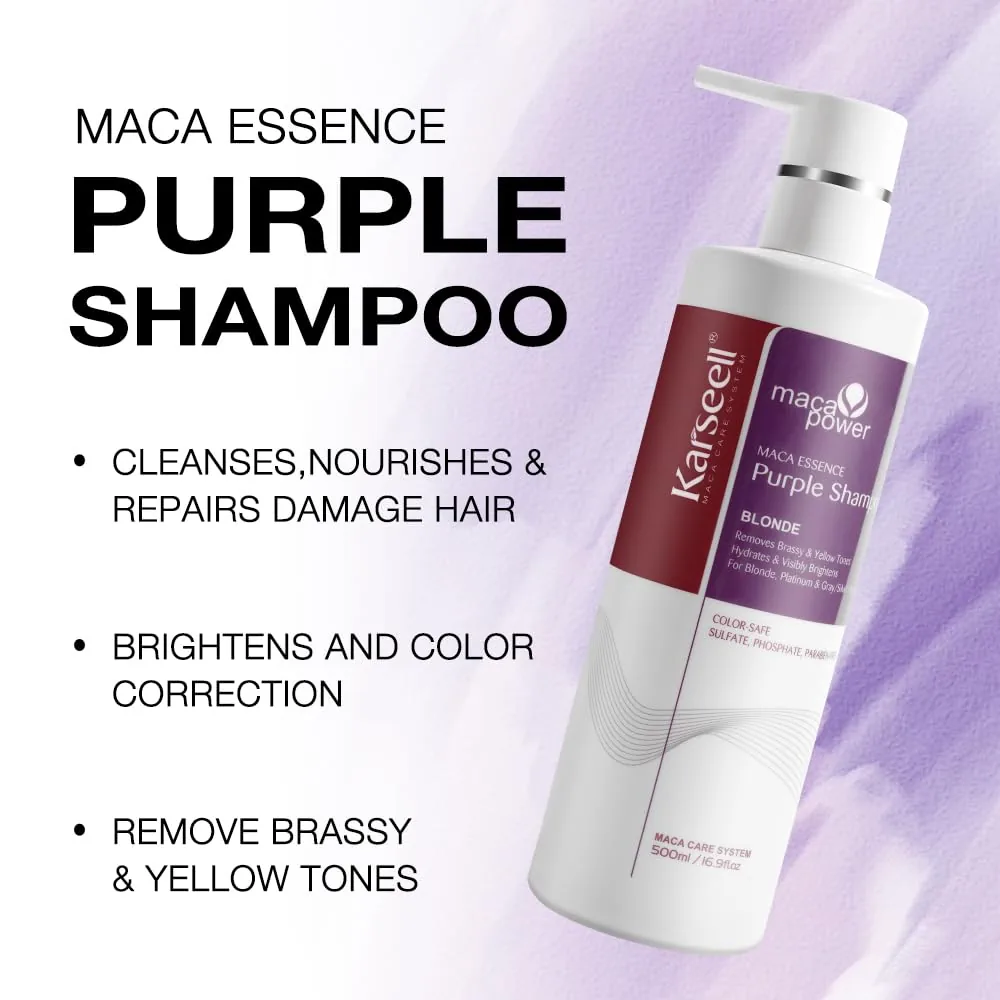
| Karseell option | Purple Shampoo | Purple Hair Mask |
The simple rule: if your brassiness is mild and you want to keep it under control between appointments, use the shampoo every couple of washes. If your colour has gone properly brassy and you want it back to clean in one go, use the mask, and give it its full contact time.
Which one you actually need
Our guide to purple shampoo vs purple mask goes into the detail, and how purple hair masks work explains the chemistry in more detail.
The Karseell Toning Products
| Product | Price | Rating | Reviews | Best for |
|---|---|---|---|---|
| Karseell Purple Shampoo | $23.99 | 4.98 | 233 | Routine toning between salon visits |
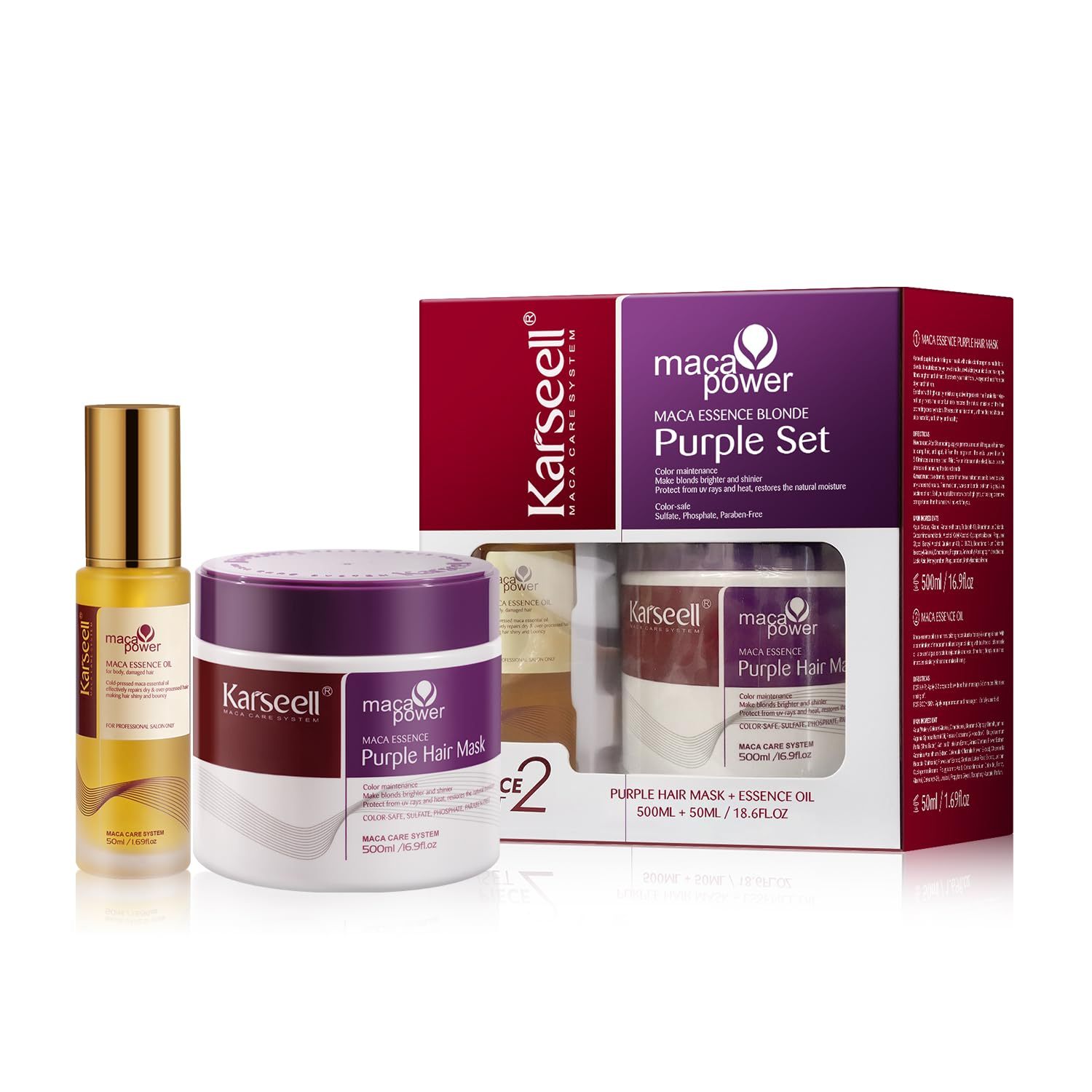
| Karseell Purple Hair Mask | $18.99 | 4.97 | 393 | A stronger reset on brassy blonde |
| Purple Hair Mask with Argan Oil | $41.99 | 4.97 | 589 | Toning plus a richer, less frizzy finish |
| Purple Hair Mask + Purple Shampoo Set | $59.39 | 4.89 | 241 | Both steps in one purchase |
Which one for your hair
You want routine maintenance. The Karseell Purple Shampoo at $23.99, rated 4.98 from 233 reviews. Its page carries the moisturising positioning common to the range — argan oil rich in vitamin E to repair split ends, bring shine and protect against UV damage, plus an Italian-formula scent with argan and coconut oil extracts.
Your blonde is properly brassy. The Karseell Purple Hair Mask at $18.99, rated 4.97 from 393 reviews, is the cheapest way into the purple range and the strongest deposit. Its page says it neutralizes brassiness in blonde shades and is suitable for all hairstyles as part of bleached blonde hair care. Note that the same page warns it is not a colorant and that natural dark hair will not show results.
You want toning and conditioning in one product. The Purple Hair Mask with Argan Oil at $41.99, rated 4.97 from 589 reviews, has the largest review count in this group. The page describes a rich, luxurious texture, a silky soft finish, less frizz, and argan oil nourishing brittle, damaged hair. It is $23.00 more than the standard purple mask, and that difference buys you the richer cream rather than a stronger pigment.
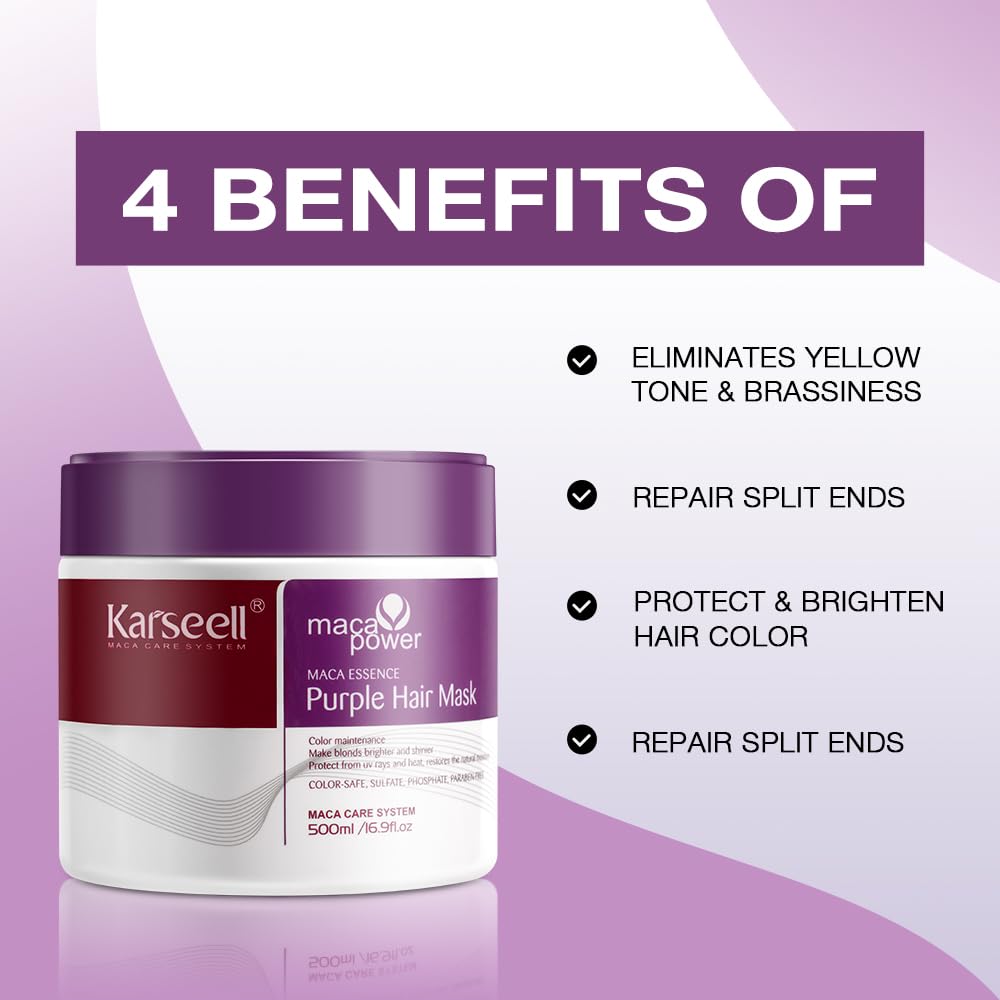
You want both steps covered. The Purple Hair Mask + Purple Shampoo Set at $59.39, rated 4.89 from 241 reviews, is described on its page as keeping blonde, bleached or silver hair cool and fresh by eliminating yellow and orange tones, with deep conditioning that leaves hair silky, smooth and manageable. It is worth doing the arithmetic, though: the $23.99 shampoo and the $18.99 mask bought separately come to $42.98, so the set carries roughly a $16.41 premium. Worth it if you are starting from scratch, less so if you already have one of the two.
Browse the full shampoo range and the purple hair mask range to see everything side by side.
How to Use a Toning Shampoo
The application steps
- Do a strand test first. This is not optional advice, it is the single most important step. The Purple Hair Mask page says to perform a strand test first, and on bleached hair it is doubly important: porous hair grabs pigment quickly and unevenly.
- Use it on clean, damp hair. Toning on hair that still has conditioner or mask residue on it will not deposit evenly.
- Work it through and leave it. Let it sit for the time the product specifies, then rinse thoroughly with cool or lukewarm water. Hot water opens the cuticle and can leave the tone patchy.
- Keep it off the scalp. The product page advises avoiding scalp contact to prevent irritation.
- Follow with your moisturising routine. Toning dries hair out if you leave it there. Condition after, every time.
- Store it cool and dry. The Purple Hair Mask page is explicit about storing the jar in a cool, dry place to maintain consistency — heat and humidity are what ruin these formulas.

Our step-by-step guide to what purple shampoo does to brassy blonde hair covers the technique in more detail, including how long to leave it on.
How Often to Use It
A realistic schedule
Every two to three weeks is the usual answer for a toning shampoo, and the guidance on the frequency is covered in full in our article on how often to use purple shampoo. Three adjustments change that:
- Soften the schedule if you are in hard water, swim regularly, or use hot styling tools. All three strip tone faster.
- Tighten it up if your brassiness returns within days of toning. That usually means your porosity is very high and the pigment is lifting early, so a strand test and a shorter contact time will serve you better than more frequent washing.
- Never use it on every wash unless your stylist has told you to. Daily toning is how you end up with dry hair and a dull, flat, greyish cast that no amount of toning fixes.
And if your hair feels rough and thirsty after toning, that is not a signal to tone more. It is a signal to add a moisturising wash, or to move your next toning session a week later.
Over-Toning and Build-Up
Over-toning is the most common complaint we hear about, and it is entirely preventable. The symptoms are recognisable:
- A dull, flat look instead of a clean, bright tone
- A faint lilac or greyish cast that does not wash out
- Hair that feels dry and brittle even though you are toning it
Pigment on the outside of the fibre does not always rinse away cleanly. It builds up, and it dulls. When that happens, the fix is a clarifying shampoo or a gentle chelating treatment, followed by deep conditioning — not more purple. Our guide to maintaining blonde hair without brassiness has the full reset routine.
And if you are not sure whether what you are seeing is brassiness or build-up, that is exactly the question a strand test answers, because it shows you the true colour underneath.
Preventing Brassiness in the First Place
Habits that help
Toning is maintenance, and maintenance is cheaper than rescue. A few habits do most of the work:
- Wash in lukewarm or cool water. Hot water is the fastest route to brass.
- Wash less often. Every wash is an opportunity for pigment to lift and for tone to shift.
- Use a filter if your water is hard. Minerals dull the fibre and make everything you apply work harder.
- Protect against UV. The argan-oil formulas in this range are described as protecting against UV damage, and melanin oxidation in sunlight is what drives brassiness in the first place.
- Heat styling at a lower temperature and with a protectant.
- Condition after every wash. Dry bleached hair is what makes colour lift and look dull.
If your hair is also damaged from the bleaching itself, that is a separate problem that toning will not solve. Our guide to how purple hair masks work covers the conditioning side of a mask, and keeping blonde hair without brassiness covers the routine around it.
Frequently Asked Questions
What does a toning shampoo actually do?
It deposits a counter-pigment that visually cancels the warm undertones in your hair. Violet cancels yellow, blue cancels orange. It does not lighten your hair, darken it, or change your level. The effect is temporary and washes out over several washes, which is why it needs repeating.
Does a toning shampoo damage bleached hair?
Used every wash, it can. Toning products that sit on the hair for any length of time can dry it out, and bleached hair has less natural moisture to begin with. Used every two to three weeks, with conditioner after, most people find it is a net positive. If your hair feels thirstier after a tone, space the sessions out and add a mask.
Can I use a toning shampoo on natural dark hair?
No. There is no brassiness to cancel, so the pigment has nothing to work against and can leave your hair looking dull or uneven. The Karseell Purple Hair Mask page states it directly: it is designed for bleached hair at level 8 and above, and natural dark hair will not show results.
Why is my blonde going grey and flat instead of brassy?
That is build-up or dryness, not brassiness, and toning will make it worse rather than better. It happens when repeated toning leaves a film that dulls the colour. Clear it with a clarifying shampoo, deep condition, and then leave the tone alone for a few weeks. If the hair still looks flat after that, the problem is moisture rather than pigment.
