

There is a hair mask price guide question hiding inside every product page, and it is not really about price. It is about whether the jar you are about to open will be finished in three weeks or still sitting on the shelf in November. Price per tub is the number on the shelf. Price per treatment is the number that decides whether a product was worth buying.
This guide walks through what the market actually charges at each tier, what you tend to get for it, and how to work out the true cost of a treatment before you commit. Then we build a price ladder from the masks, sachets and sets in the Karseell hair mask range, so you can see the whole ladder in one place instead of guessing from a search result.

Start With the Real Question
Two masks can cost the same and behave completely differently. One is a rich, thick treatment for bleached ends that takes 20 minutes. The other is a light rinse-out formula you use after every wash. Neither is better in the abstract; they are built for different hair and different budgets.
So before comparing prices, decide two things:
- What is wrong with your hair? Dry and frizzy, damaged and brittle, thick and thirsty, or bleached and brittle? The answer sets the format and the price tier.
- How often will you actually use it? A product you use weekly and a product you use twice a year should never be compared on sticker price.
Everything below assumes the second question matters. It is the one shoppers skip, and it is why the same $30 mask gets a five-star review from one person and a one-star from the next.
What Each Price Tier Actually Buys You
Tier 1: Drugstore, $5 to $20 per tub or jar
This is where most people start, and where a lot of good hair care lives. Drugstore hair masks typically retail between $5 and $20 per tub or jar. You get a solid rinse-out conditioner-mask hybrid, usually with one or two hero ingredients such as coconut oil, shea butter or argan oil. The formulas will not rebuild a bleached structure, but for dry, ordinary hair they are more than enough.
Tier 2: Home treatment, $15 to $35 per jar
A deep conditioning mask bought for home use runs $15 to $35 and lasts 5 to 10 applications, and a hot oil treatment runs $10 to $25 per session. This is the middle of the market and, for most people buying for dry or damaged hair, it is the sweet spot. You start paying for richer textures, higher loads of conditioning oils and proteins, and formulas tested on bleached and heat-stressed hair.
Tier 3: Luxury, $30 to $200+ per tub or jar
Luxury hair care commonly runs $30 to $200+ per tub or jar. What you are usually buying at this level is a specific targeted active, and a brand’s research and marketing budget. Sometimes there is a genuinely better formula in there, and sometimes the difference is texture and finish. Our guide to drugstore versus luxury hair masks digs into where the premium actually goes.
The Kaseell Price Ladder, Product by Product
Kaseell is a Guangzhou-based hair care brand with more than 20 years of OEM and ODM manufacturing, exporting to 130+ countries, and the products are built around argan oil, maca, collagen, keratin and botanical extracts. Here is the ladder as it actually stands, from the entry jar to the full routine.
$15.99 — the 500ml Collagen Hair Mask
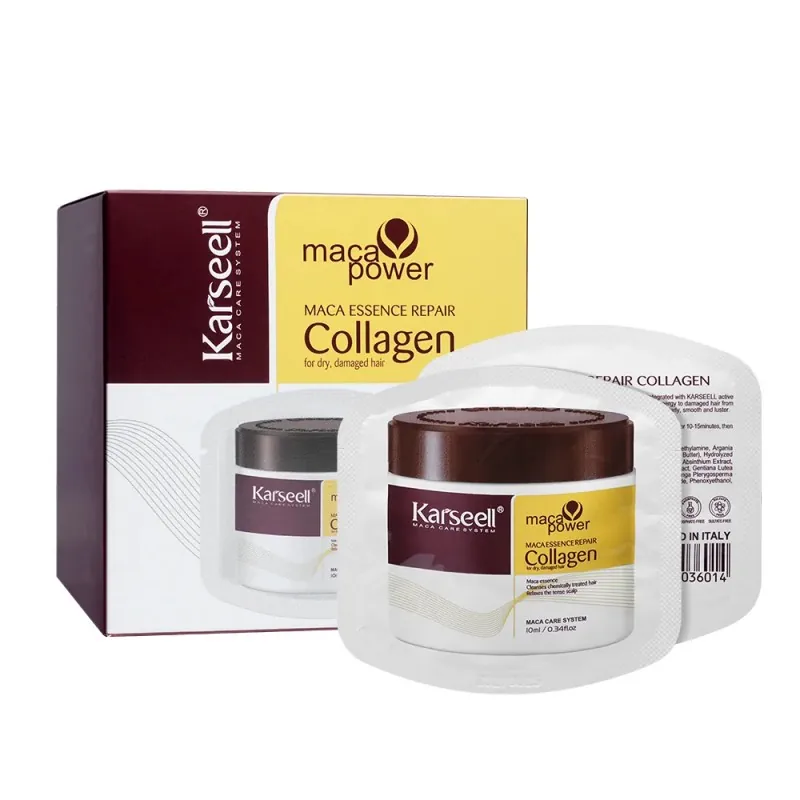
The Karseell Collagen Hair Mask is infused with collagen, keratin and argan oil, takes 5 to 10 minutes, and is rated 4.98 out of 5 from 1,063 reviews. It sits at the bottom of the ladder because the jar is large and the price is not. If you only ever buy one mask, this is the one to start with.
$19.79 — 24 individually portioned packs
The Karseell Collagen Hair Mask 24 packs is sold as 24 single-use sachets, each one treatment, so every dose is fresh and nothing goes stale in an open jar. Rated 4.95 from 236 reviews. This is the format that wins on portability and consistency, not on price per jar.
$29.69 — the bagged 500ml mask
The Karseell Collagen Hair Mask Bag keeps the same 500ml formula in a pouch designed to limit contact with light, air and moisture, and it folds down for storage. Rated 4.94 from 282 reviews. You pay a little more for the packaging, and you get the same product in a shape that suits small bathrooms and travel.
A mask and argan oil bundle sits one rung above at $43.99, and the mask with a leave-in conditioner sits at $33.99, rated 4.99 from 109 reviews — that set pairs a 100ml travel mask with a leave-in for the days between washes, which is a two-product routine rather than a single treatment.
$66.99 — the full three-piece routine
The Karseell 3-Piece Hair Moisture and Repair Set contains one 500ml rinse-out mask, one 500ml moisture shampoo and one 500ml repair conditioner. Rated 4.98 from 389 reviews. It is the only item on the ladder that replaces a whole wash day, which is why it is hard to compare on price alone. Our hair care set category has the rest of the bundle options.
Cost per Treatment: The Only Number That Matters
Here is the ladder converted into the number that actually matters. The jar figures assume 15 to 20 uses, which is the realistic range for a 500ml rinse-out mask used weekly.
| Product | Price | What you get | Cost per treatment |
|---|---|---|---|
| Collagen Hair Mask, 500ml jar | $15.99 | 15 to 20 uses, once weekly | $0.80 to $1.07 |
| Collagen Hair Mask, 24 packs | $19.79 | 24 single-use sachets | $0.82 per sachet |
| Collagen Hair Mask Bag, 500ml | $29.69 | 15 to 20 uses, once weekly | $1.48 to $1.98 |
| Collagen Mask + Leave-in Conditioner | $33.99 | 100ml travel mask plus a leave-in | Two products, so no single treatment figure |
| 3-Piece Moisture and Repair Set | $66.99 | 500ml mask, shampoo and conditioner | $3.35 to $4.47 for the whole routine |
The last two rows need a note. The mask and leave-in set contains a 100ml travel-size mask, so it will not stretch as far as a 500ml jar, and the leave-in is a daily step used for weeks rather than minutes. The three-piece set spread over 15 to 20 mask treatments gives $3.35 to $4.47 per treatment, and that figure already covers your shampoo and conditioner.
Which Tier Your Hair Actually Needs
Here is the honest mapping, based on what each product in the range is formulated to do.
- Fine, thin or oily hair. Start at the bottom of the ladder. The $15.99 jar used every two weeks will do more for you than an expensive mask used once and forgotten. Rich formulas flatten fine hair, so use less product than you think you need.
- Dry, frizzy, colour-treated hair. The middle of the ladder, used weekly, is where most people get the best return. This is where the $15.99 to $33.99 products sit.
- Bleached, heat-damaged or chemically processed hair. Mid to premium tier, and treat the 5 to 10 minute window as a minimum. You also need a leave-in or oil step for the days between washes.
- Thick, curly or coily hair. Budget by volume, not by price. A $16 jar can disappear in four uses on long, dense hair, and the 500ml formats and sets exist for exactly this reason.
- Rebuilding a whole routine. A set is not automatically cheaper per treatment, but it removes the guesswork and usually costs less than buying three things separately.
The Three-Question Check Before You Buy
Ask yourself: how often will I use this, what problem is it solving, and how long will the bottle last me at that rate? If you cannot answer all three, you are not ready to buy, no matter which tier the product sits in. The complete guide to hair masks goes deeper on choosing by hair type.

The Honest Truth About Expensive Masks
A cheap mask used consistently beats an expensive one sitting unused. That is not brand loyalty or a discount argument, it is just how product works. A $60 formula used twice a year delivers two treatments of benefit. A $16 formula used weekly delivers fifty-two. The expensive one also has to overcome the risk that you never open it at all.
That said, price does correlate with something real. Luxury masks tend to be richer in emollients and formulated for difficult hair such as bleached, over-processed or very thick hair. If your hair has been through several chemical processes, the mid-to-premium tier is where the money is better spent.
What premium pricing does not buy is a miracle. No mask un-bleaches hair. If a product page implies otherwise, that is marketing, not formulation. Our roundup of masks for dry and damaged hair compares the options on properties rather than price alone.
Getting More Treatments From Any Jar
The cheapest way to lower your cost per treatment is to stop wasting product. A few habits do most of the work.
- Apply to damp hair, not dripping wet. Water dilutes the formula before it can do its job.
- Use a measured amount. Most people overapply. A coin-sized amount for shoulder-length hair is usually enough.
- Focus on the mid-lengths and ends, which is where damage shows, and keep it away from the scalp.
- Follow the time on the label. Ten minutes is not the same as twenty, and twenty minutes is not the same as an hour.
- Do not mix two masks together to get a stronger result. You cannot predict what the ratio will do.
- Use the sachets for travel and the jar at home. That way the jar never goes stale waiting for a trip.
For timing and frequency, including what happens if you use a mask too often, see how often you should use a hair mask.

At Home vs Salon: Where the Money Goes
Home hair treatments cost $5 to $30 per session, while professional salon treatments typically run $50 to $300 per visit. Once you add up what a year of salon visits costs versus a year of doing it yourself, the numbers stop being close.
- Cost per session at home is about $3 to $15 after any one-time equipment investment.
- Cost per session in a salon is $35 to $400.
- Over 12 months, weekly at-home treatments cost roughly $156 to $780, against $420 to $4,800 a year for monthly salon treatments.
That gap is the clearest argument in haircare. A well-chosen home mask, used consistently, gets you most of the visible benefit of a salon treatment for a fraction of the price. A salon visit is worth it when you want a specific service — a colour correction or a professional blow-dry — not because the jar in the salon is a nicer jar. Our full at-home versus salon cost comparison breaks the numbers down further.

Frequently Asked Questions
Is a more expensive hair mask actually better?
Sometimes, and the difference is usually texture and how the formula is built for difficult hair rather than a miracle effect. For ordinary dry or frizzy hair, a well-made mid-range mask performs almost identically to a luxury one. The expensive option earns its place on bleached, heat-damaged or chemically processed hair.
How long should a $20 hair mask last?
A 500ml jar used weekly typically gives 15 to 20 applications, so roughly four to five months. A single-use sachet gives one treatment, and a 100ml travel jar gives fewer than a full-size bottle would. If you are storing an open jar in a humid bathroom, expect a shorter life and a slightly less fresh formula.
Is it worth buying a hair mask set instead of one jar?
It is worth it when you are replacing a whole routine, because a set covers shampoo, treatment and aftercare in one purchase and usually costs less than the pieces bought separately. It is not worth it if you only need the mask, since the single jar at $15.99 is the cheapest way to start and the lowest cost per treatment on the ladder.
How often should I use a hair mask at home?
Once a week for most hair. Every two weeks if your hair is fine or gets oily quickly, and twice a week if it is very dry, coarse or bleached. If you are layering a mask with a leave-in, start at once a week and increase only if the hair still feels thirsty.
