

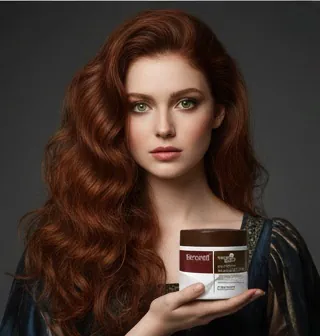
What Is Thick Hair?
- Takes longer to dry
- Harder to style or straighten
- Prone to tangling if not properly conditioned
- May appear unruly without regular trims
What Is Fine Hair?
- Lacks volume and appears limp
- Gets oily quickly at the roots
- Easily damaged by heat or chemical treatments
- Struggles to hold curls or updos
How to Tell Your Hair Type
- If your hair is thicker than the thread → you likely have thick hair.
- If it’s about the same width → medium.
- If it’s thinner → you have fine hair.
Tailoring Your Hair Care Routine
- Use moisturizing shampoos and deep-conditioning masks weekly.
- Look for ingredients like argan oil, shea butter, and collagen.
- Avoid sulfates that over-strip natural oils.
- Apply leave-in conditioners or hair oils to tame frizz.
- Choose clarifying or volumizing shampoos that remove buildup.
- Use lightweight conditioners applied only from mid-length to ends.
- Limit heavy oils or silicones that flatten hair.
- Opt for protein-based treatments to strengthen without adding weight.
Styling Tips
- Thick hair: Blow-dry with a round brush for smoothness; use anti-frizz serums before heat styling.
- Fine hair: Tease gently at the roots for lift; use texturizing sprays instead of gels or creams.
Why Product Choice Matters
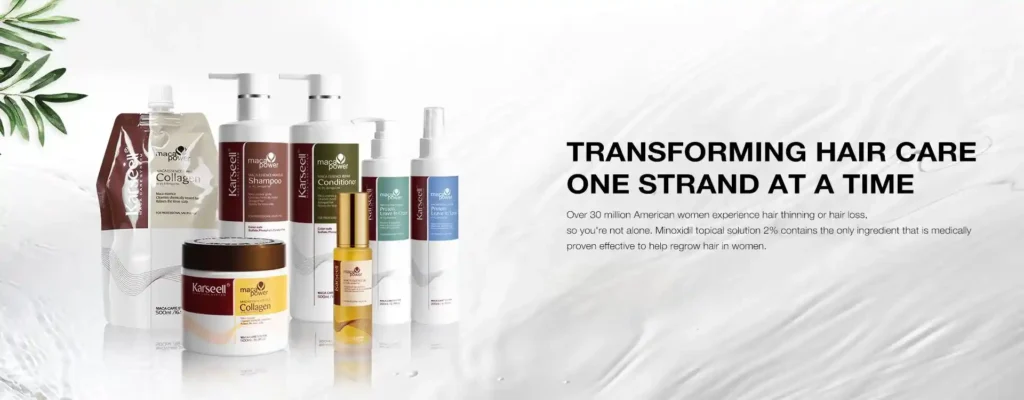
Introducing Karseell: Precision Hair Care for Every Type
How to Identify Your Hair Type and Why It Matters
Hair type is determined by the shape of the hair follicle, which is set genetically. Understanding your hair type helps you choose the right products and techniques for your specific needs.
Hair type is classified along two primary dimensions: texture (the diameter of the individual hair strand) and pattern (the curl or wave shape).
Texture ranges from fine (the thinnest strand diameter) through medium to coarse (the thickest). Fine hair is delicate and prone to being weighed down by heavy products. Coarse hair is strong but can be difficult to condition and style. Medium hair falls in between and is generally the easiest to manage.
Hair pattern ranges from straight (Type 1) through wavy (Type 2) to curly (Type 3) and coily (Type 4). Within each type, there are subcategories (A, B, C) that indicate how tight or loose the pattern is.
For Karseell product selection, the texture dimension is most important. Fine hair benefits from smaller amounts of product applied from mid-lengths to ends. Coarse hair benefits from generous application and longer processing times. Both benefit from the collagen and argan oil combination, but the application technique should be adjusted for best results.
Thick Hair vs Fine Hair: Key Differences in Care
The terms thick and fine refer to the diameter of individual hair strands, not the overall density or volume of hair. You can have thick strands in a sparse pattern or fine strands in a dense pattern.
Thick hair strands have more cortex and more structural protein, making them naturally stronger but also more resistant to conditioning. The cuticle layer in thick hair is often more compact and less permeable, meaning conditioning ingredients take longer to penetrate.
Fine hair strands have less cortex and less natural strength, making them more prone to breakage. The cuticle is often more permeable, meaning they absorb moisture and products more quickly but also lose moisture more readily.
For thick hair: Use generous amounts of the Karseell Collagen Hair Mask. Extend processing time to 10 minutes or more. Use a shower cap to trap heat and enhance penetration. Follow with Karseell Argan Oil for effective sealing.
For fine hair: Use modest amounts of the mask. Apply from mid-lengths only. Limit processing time to 3 to 5 minutes. Use a small amount of argan oil on the ends only.
The Moisture Needs of Different Hair Types
Every hair type needs moisture, but the type and amount of moisture needed varies significantly.
Straight hair tends to distribute sebum from the roots along the entire strand, so it is naturally the most moisturized type. However, straight hair is also most susceptible to becoming limp and flat when over-moisturized.
Wavy hair has moderate moisture needs. Sebum travels partway down the strand before gravity takes over, leaving the mid-lengths and ends drier than the roots. Wavy hair benefits from regular conditioning applied from the mid-lengths downward.
Curly and coily hair has the highest moisture needs because the curl pattern prevents sebum from traveling down the strand effectively. The tight turns in curly hair also create more cuticle surface area that can lose moisture. Curly and coily hair is almost always under-moisturized and benefits from the most generous use of hydrating products.
The Karseell Collagen Hair Mask and Argan Oil combination is appropriate for all hair types because it delivers both hydration and sealing, regardless of how much natural moisture the hair already has.
Frequently Asked Questions
I have thick but fine hair. Which category should I follow?
Follow the fine hair guidelines for product amount and application technique. The key difference is that thick-but-fine hair has more surface area to coat, so you may need slightly more product than a typical fine-hair person, but you still need to avoid the root area and scalp.
How do I know if my hair is medium texture?
If your hair is not noticeably fine (you can feel a strand between your fingers and it feels substantial) and not noticeably coarse (it does not feel wiry or stiff), you are likely medium texture. Most people are medium texture. Follow the standard application guidelines for medium hair: moderate product amount, 5 to 7 minutes processing time.
Can thick hair become thinner over time?
Yes. Hair can become finer (thinner in strand diameter) due to age, hormonal changes, nutritional deficiencies, and accumulated damage. This is different from hair loss. Using the Karseell Collagen Mask supports the health of existing strands, which can help maintain the apparent thickness of your hair.
Is there such a thing as too much conditioning for thick hair?
Yes, but it is rare. Over-conditioning (protein overload) occurs when too much protein is applied without adequate moisture, making hair stiff and brittle. The Karseell Collagen Mask provides a balanced ratio of protein and moisture, so it is very difficult to over-condition with this product alone.
