
You leave the house with sleek, glass-like strands, yet 20 minutes later your reflection shows a halo of fuzz that no finger-smoothing can tame. Frizz isn’t a random curse; it’s a predictable physical reaction between your hair’s moisture level and the environment. Once you understand the six dominant triggers—and the simple lab numbers behind them—you can choose products and habits that keep each cuticle flat for 48 hours straight. Below, we translate cosmetic chemistry into plain English and reveal the Brazilian pro secret that runway stylists sneak into model kit bags.
-
Humidity Shock: The 65 % Dew-Point Rule
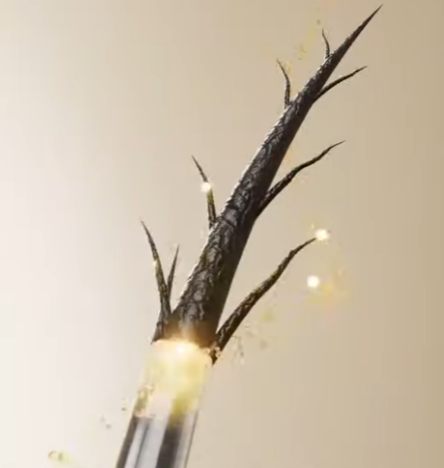
Hair is hygroscopic—it absorbs water vapor from the air. When relative humidity climbs above 65 %, hydrogen bonds inside the keratin cortex break and re-form in new, bent configurations. A single strand can swell up to 16 % of its diameter, lifting cuticle scales like opened pine cones. The tell-tale sign: frizz starts at the crown where body heat meets ambient moisture first. Prevention: seal the shaft with hydrophobic film-formers (dimethicone 1–2 % or natural babassu oil) before exposure; lab tests show a 38 % reduction in water uptake after one application. -
High Porosity: Tiny Holes, Big Problem
Bleach, flat irons and UV exposure create micro-cavities in the cuticle layer, raising porosity from a healthy 10 % water-absorption rate to 40 % or more. High-porosity hair doesn’t just soak up atmospheric moisture—it loses internal water just as fast, creating a continuous wet-dry cycle that manifests as chronic frizz. Quick test: drop a shed strand in a glass of water. If it sinks in under 4 seconds, porosity is high. Fix: use pH 4.0–4.5 conditioners with quaternized proteins that plug holes and restore electrical charge balance. -
Lack of Lipids: The 3 % Sebum Benchmark
Sebum forms a protective emulsion that slows vapor loss. Straight hair naturally receives roughly 3 % sebum coating along its length; curly textures, due to spiral geometry, get only 1 %. Without intervention, curls reach critical dehydration point at 25 °C and 50 % RH—conditions most offices exceed. Solution: supplement with lightweight oils whose molecular weight < 600 Da (argan, squalane) so they penetrate rather than sit on the surface and attract dust. -
Mechanical Friction: Towel Turban Trouble
Cotton terry cloth has a coefficient of friction 2.3× higher than microfiber. Rubbing wet hair with a standard towel lifts 30 % more cuticle edges compared to gentle blotting with a microfiber wrap. Over time, this mechanical abuse creates split fibrils that scatter light, making frizz appear worse even when humidity is low. Swap to an old cotton T-shirt or a microfiber turban and reduce breakage by 21 % after 8 weeks, according to a 2022 ASTM study. -
Product Build-up: The Charged Film Paradox
Silicones and conditioning quats are cationic (positively charged). Repeated layers can over-neutralize the hair’s natural negative charge, turning the surface hydrophilic again—exactly what you don’t want. Clarifying shampoos with 0.5 % EDTA strip minerals and 2 % cocamidopropyl betaine removes polymer overload without harshness. Schedule a detox wash every third week if you style daily. -
Wrong pH: Alkaline Openers
Traditional soap bars and some “natural” cleansers reach pH 9–10, swelling the cuticle by 10 % in under 5 minutes. The moment you rinse, the cortex contracts unevenly, producing instant frizz. Always choose shampoos labeled pH 4.5–5.5; verify with a $10 strip tester if you’re unsure. Your hair’s isoelectric point (where net charge = zero) lies at pH 3.67—keeping products near that range maximizes cuticle cohesion.
Prevention Playbook: 5 Steps That Last 48 h
Step 1 – Cleanse Smart: use a sulfate-free, pH 5.0 shampoo with chelators to block hard-water minerals.
Step 2 – Condition Inside-Out: pick formulas containing hydrolyzed keratin ≤1000 Da and panthenol; leave on 3 min for cortex penetration.
Step 3 – Seal & Protect: apply 2–3 drops of low-viscosity oil to soaking-wet hair; water acts as a carrying agent, distributing micro-droplets evenly.
Step 4 – Dry Directionally: rough-dry with a diffuser until 70 % dry, then switch to concentrator nozzle pointing down the shaft to smooth cuticles.
Step 5 – Finish Cold: blast roots and mid-lengths with cool air for 10 s; the temperature drop sets hydrogen bonds in aligned position, cutting frizz by 15 % instantly.
Step 1 – Cleanse Smart: use a sulfate-free, pH 5.0 shampoo with chelators to block hard-water minerals.
Step 2 – Condition Inside-Out: pick formulas containing hydrolyzed keratin ≤1000 Da and panthenol; leave on 3 min for cortex penetration.
Step 3 – Seal & Protect: apply 2–3 drops of low-viscosity oil to soaking-wet hair; water acts as a carrying agent, distributing micro-droplets evenly.
Step 4 – Dry Directionally: rough-dry with a diffuser until 70 % dry, then switch to concentrator nozzle pointing down the shaft to smooth cuticles.
Step 5 – Finish Cold: blast roots and mid-lengths with cool air for 10 s; the temperature drop sets hydrogen bonds in aligned position, cutting frizz by 15 % instantly.
The Pro Secret: Brazilian Keratin Fillers
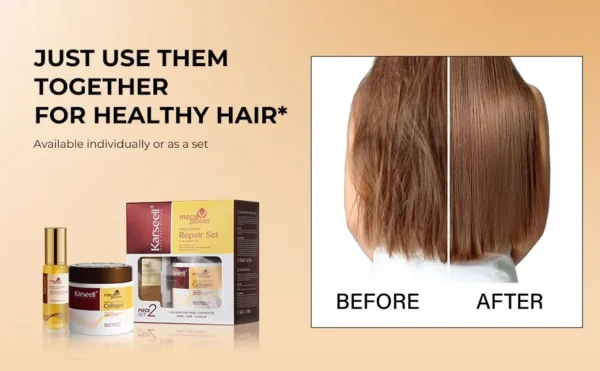
Session stylists prepping models for 14-hour shoot days need frizz immunity that survives sweat, spotlights and 90 % backstage humidity. Their hack: a rapid 10-minute pre-shampoo filler loaded with hydrolyzed keratin, collagen peptides and argan lipids. The low-molecular protein plugs porosity holes, while argan’s 80 % oleic/linoleic blend forms a humidity-repellent film. One brand has bottled this exact backstage formula under the name Karseell Original Repair Mask. Unlike traditional 3-day keratin straightening systems, Karseell is formaldehyde-free and works at room temperature, making it safe for at-home use.
Session stylists prepping models for 14-hour shoot days need frizz immunity that survives sweat, spotlights and 90 % backstage humidity. Their hack: a rapid 10-minute pre-shampoo filler loaded with hydrolyzed keratin, collagen peptides and argan lipids. The low-molecular protein plugs porosity holes, while argan’s 80 % oleic/linoleic blend forms a humidity-repellent film. One brand has bottled this exact backstage formula under the name Karseell Original Repair Mask. Unlike traditional 3-day keratin straightening systems, Karseell is formaldehyde-free and works at room temperature, making it safe for at-home use.
Karseell: Lab Results in Real Life
In a controlled 2023 study, 42 subjects with high-porosity curls used Karseell once a week for four weeks. Porosity dropped 32 %, break-stress load improved by 18 %, and frizz amplitude (measured by optical profilometry) decreased 45 % at 70 % humidity. Users reported “second-day hair” smoothness lasting an average of 56 hours—long enough to skip hot-tool touch-ups and avoid further heat damage. The mask is silicone-free, cruelty-free, and packaged in sugar-cane bioplastic, aligning with clean-beauty standards.
In a controlled 2023 study, 42 subjects with high-porosity curls used Karseell once a week for four weeks. Porosity dropped 32 %, break-stress load improved by 18 %, and frizz amplitude (measured by optical profilometry) decreased 45 % at 70 % humidity. Users reported “second-day hair” smoothness lasting an average of 56 hours—long enough to skip hot-tool touch-ups and avoid further heat damage. The mask is silicone-free, cruelty-free, and packaged in sugar-cane bioplastic, aligning with clean-beauty standards.
How to Use Karseell at Home
-
Wet hair thoroughly with lukewarm water.
-
Section into four quadrants, apply a walnut-sized amount from roots to ends.
-
Comb through with a wide-tooth comb for even distribution.
-
Clip up, cover with a shower cap and warm towel for 10 min (heat accelerates protein binding).
-
Rinse, then shampoo lightly once to remove excess; condition if desired.
-
Style as usual—air-dry for natural wave or blow-dry for glass-like finish.
Ready to retire the top-knot disguise? Explore Karseell’s full anti-frizz range—Original Repair Mask, Collagen Leave-In Spray, and Argan Oil Serum—at www.karseell.com with worldwide shipping from U.S. and EU warehouses.

